In 2026, CIOs continue to navigate a volatile landscape characterized by the rapid pace of technological change, advancements in artificial intelligence, escalating cybersecurity threats, and an increasingly complex geopolitical environment. These challenges demand vigilance and adaptability, as organizations aim to maintain operational stability amid global uncertainty.
At the same time, CIOs are focused on driving AI innovation and integrating agentic AI solutions throughout the enterprise, as they try to improve productivity and create efficiencies. They are prioritizing organizational agility and balancing resources to advance digital transformation and risk management initiatives.
According to the Gartner 2026 CIO Agenda Preview, “The drive for better productivity, lower costs and profitable growth remains a constant, yet these pressures, already heightened in 2025, will intensify further in 2026.”
Our annual Leadership Perspective Survey of CIOs across our communities demonstrates similar trends – CIOs are focused on operationalizing AI, while strengthening cybersecurity and data and analytics strategies. Here, we take a closer look at these three critical priorities for CIOs, based on our proprietary survey of 1,400 IT executives across Gartner C-level Communities.
Top Functional Priorities for CIOs
Initially, “Cybersecurity and Risk Management” emerged as the top priority for IT leaders; however, as more CIOs participated in the 2026 survey, “Operationalizing AI” overtook it to become the leading functional priority.
For the past four years, cybersecurity has consistently ranked as the top priority, while AI has shown its increasing importance, growing from the fourth spot in 2024 to the top spot in 2026. “Data and Analytics” has remained a consistent focus area for CIOs over the past several years.
This year, we updated our survey response options to better capture the shifting priorities of CIOs, separating AI into two focus areas. “Operationalizing AI” is aimed at IT leaders who are actively integrating AI into business processes and expanding its implementation, while “Developing an AI Strategy” pertains to those defining the overarching vision and pinpointing the most valuable use cases for AI within their organizations.
In addition, “Modernizing the Applications Portfolio” has reentered the top five priorities after briefly falling lower on last year’s list, while “Evolving IT Strategy, Governance and Operating Models” continues to be a key area of focus for CIOs in 2026.
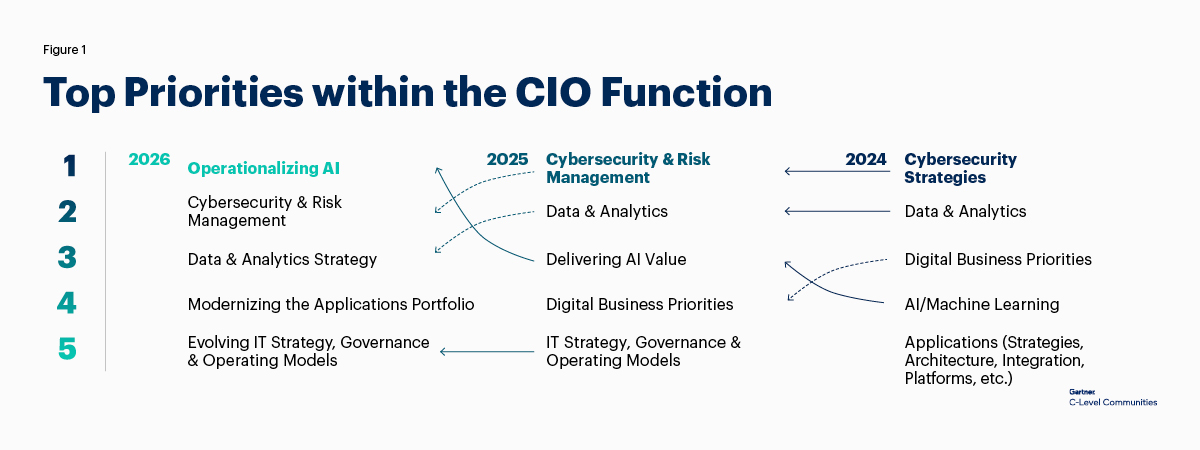

Next, we take a closer look at each of the top three priorities for CIOs, examining the key opportunities and challenges they have identified in these areas.
Moving from AI Concepts to Real-World Applications
CIOs who are prioritizing operationalizing AI are generally more advanced in their adoption, with some reporting thousands of use cases and a shift toward deploying agentic AI and automation initiatives. Their focus has moved from experimentation to embedding AI capabilities into business processes and extracting measurable value.
There is a growing emphasis on assessing real impact, rather than engaging in hypothetical discussions, with CIOs questioning whether some implementations are truly transformative. As one CIO commented, “AI remains central to technology conversations, but the initial excitement is fading as tangible returns are yet to be seen.”
For CIOs who are advancing toward agentic AI, they are focused on democratizing the technologies across business segments and exploring how agentic systems will reshape the workforce. While engineering teams are dedicating time to agentic AI initiatives, one challenge is in driving adoption among non-engineers. As another IT executive commented, “The biggest challenge for non-engineers is finding use cases across the organization for various roles.” CIOs are also grappling with governance and security as they scale and connect a growing number of AI agents, and they are seeking effective guardrails to manage this issue.
In 2026, CIOs are increasingly focused on leveraging AI to drive efficiencies and boost productivity. Their efforts span automating both large-scale and department-specific tasks, offloading routine work, and measuring tangible outcomes, such as the percentage of calls handled by AI in call centers. There is a strong emphasis on ensuring AI initiatives deliver real, measurable value with ongoing challenges in quantifying ROI. One CIO shared that “measuring ROI, especially in terms of time savings, can be challenging and may require both objective and subjective metrics.”
The following outlines CIOs’ specific objectives and challenges in generating value from AI initiatives. While most IT leaders aim to enhance business outcomes, their primary challenge remains a shortage of skilled talent in this area.
Goals for Operationalizing AI
74% Improving business outcomes
63% Improving processes and efficiencies
44% Delivering and defining value
Challenges around Operationalizing AI
52% Lack of skills
39% Quickly changing landscape
38% Competing priorities
Following the survey, we engage in hundreds of follow-up conversations with CIOs to gain deeper insights into their priorities and challenges. Here is a sample of what CIOs told us about operationalizing AI:
We are struggling to prevent AI initiatives that lack real value. We are focusing on what everyday AI usage looks like in practice and trying to avoid AI vanity projects.
AI at scale doesn't mean everything is done with AI.
Start with business priorities and work backwards to AI solutions, ensuring AI is not a distraction but genuinely adds value.
Maintaining Vigilance in Cybersecurity and Risk Management
Cybersecurity has long been a focus area for CIOs, who increasingly emphasize the importance of fully integrating security into every aspect of business operations. IT leaders are adapting to a constantly evolving threat landscape and working closely with their peers in finance, legal and HR to align governance and cybersecurity policies. The ongoing evolution of threat actors demands continuous vigilance – reinforcing that cybersecurity will remain a top priority for the foreseeable future. As one CIO commented, “Cybersecurity will always be at the top; you're never actually safe."
CIOs face mounting challenges as AI empowers malicious actors, leading to increasingly sophisticated cyberattacks, such as deepfakes and advanced phishing. While many organizations are enhancing employee training to address these threats, security teams are struggling to keep pace with evolving attack vectors and the rise of agentic AI. An IT executive noted in their comments that “AI is making the threat actors smarter and more effective.”
In response, CIOs are focused on strengthening defense layers, implementing frameworks like Zero Trust, and prioritizing identity, authentication, and data loss prevention. At the same time, they are balancing agility with strong governance, particularly around data privacy, permissions, and access controls. The intersection of AI and cybersecurity is a frequent topic at the board level, with technology leaders recognizing the “AI paradox” – that AI is making attackers more capable, but also providing new tools for defense and threat detection.
In addition, CIOs acknowledge the need to strengthen their recovery processes in the face of inevitable disruptions. One CIO describes the strategy this way: “We need to think about the ‘minimum viable company’ and how we protect our core products.” IT leaders are shifting from a purely defensive approach to one centered on building resilience, asking whether they have done everything possible to ensure rapid recovery and organizational continuity.
For CIOs this year, their primary objective for cybersecurity strategy is to mitigate risks, and their top challenge remains the fast-moving threat landscape. Here are their other goals and challenges in the area of cybersecurity:
Goals for Cybersecurity & Risk Management
79% Mitigating risks
67% Improving resiliency
43% Complying with regulatory requirements
Challenges around Cybersecurity & Risk Management
42% Quickly changing landscape
34% Technical debt
32% Competing priorities
32% Lack of resources
Here is a sample of what CIOs told us about their cybersecurity strategies after the survey:
There is an AI paradox – AI is making attackers more capable, but AI is also helping with defense via tooling to detect and respond to threats.
Boards are now taking cybersecurity seriously, with increased alignment between technology initiatives and business goals.
We have an ongoing challenge in determining if we have ‘enough security’ to be effective without over-investing.
Enhancing Data and Analytics Capabilities
CIOs consistently emphasize that “AI and analytics success are impossible without strong data foundations,” as one stated. Ensuring data is “AI ready” is a top priority, driving ongoing efforts to improve data architecture and future-proof platforms for easy deployment of agents and integration with large language models. As part of their overall AI roadmap, CIOs are focused on data cleanup, sanitization and accessibility.
Data upkeep is viewed as a continuous process, with another CIO sharing, “Data management is an ongoing journey, with constant requirements for cleanup, governance, and architectural improvements.” In addition, CIOs are increasingly focused on managing data across diverse subsidiaries and business units. Standardizing data is essential for accurate reporting and unlocking future value. This effort requires a cultural shift with new systems, processes, and roles, like data owners and stewards to ensure data is accurate, reliable, accessible and secure.
CIOs recognize that scaling impactful use cases depends on robust data integration, master data clean-up, and moving up the data maturity curve – from looking backward with descriptive analytics to looking forward with prescriptive analytics. Organizations are expanding data teams, upskilling staff, and embedding data experts within business units to drive stronger insights and faster adoption. Key focus areas include data discoverability, stewardship, governance, and clarifying roles around access, with data sovereignty and cloud security becoming increasingly important.
CIOs’ main objective is to enable data-driven decision-making, but their greatest obstacle lies in ensuring the quality and accessibility of their data.
Goals for Data & Analytics
81% Making data-driven decisions
69% Improving business outcomes
39% Improving processes and efficiencies
Challenges around Data & Analytics
48% Data quality & availability
38% Competing priorities
37% Siloed operating model
CIOs offered additional perspectives on their data and analytics strategies, including the following:
Data strategy is integral to the overall AI roadmap with ongoing efforts in data cleanup, analytics, and improving data sanitization.
Now that the benefits of AI are clear, there is a strong focus on D&A.
Foundational work like master data clean-up is essential, but often deprioritised until a high-value use case demands it.
CIOs’ Priorities Across the Enterprise
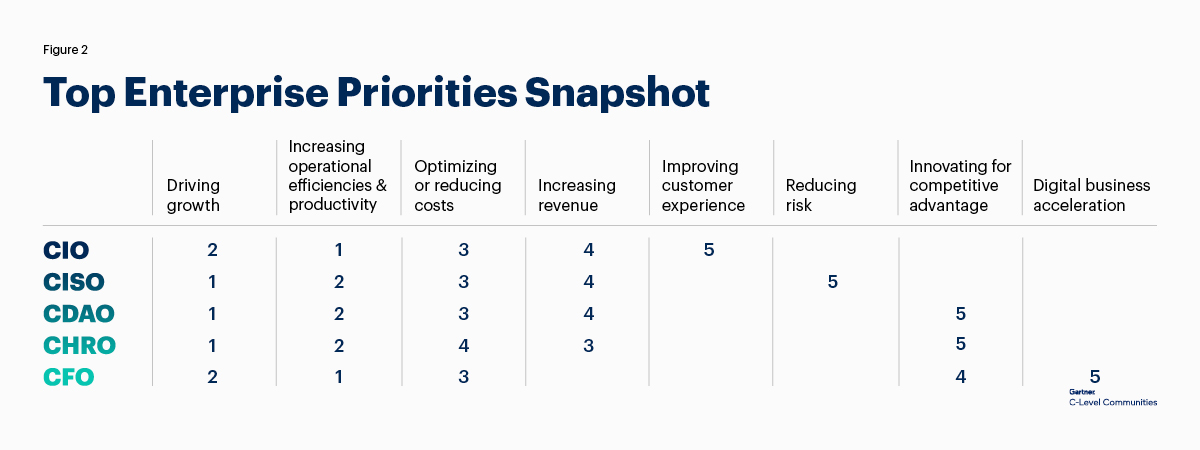
Our survey gathers insights from C-suite executives on both their enterprise-wide priorities and their specific functional goals and objectives. In 2026, CIOs selected increasing operational efficiencies and productivity as their top enterprise priority, along with their CFO peers. Their second area of focus is driving growth – the top enterprise initiative for their CHRO, CISO and CDAO peers. Across the C-suite, creating efficiencies and increasing growth captured the top two spots for priorities across the organization.
Rounding out the top five enterprise priorities for CIOs are optimizing or reducing costs, increasing revenue and improving customer experience. Aside from the top two priorities swapping positions since last year, CIOs’ enterprise priorities are unchanged from 2025. Ongoing volatility in the geopolitical landscape, much like last year, may account for the uncertainty surrounding resources and the continued emphasis on cost optimization. In addition, CIOs expect AI and other technology initiatives to streamline processes and enhance productivity.
Here is a snapshot of the top enterprise priorities cited by CIOs and their C-level peers.
The Outlook for CIOs
CIOs continue to prioritize agility in both their planning and resource allocation as they advance AI, digital transformation, and risk management initiatives. Over the past few years, they have led the charge in AI adoption and investment, focusing on creating operational efficiencies and evaluating the tangible benefits that AI can deliver to their organizations.
As AI adoption matures, the focus is shifting from experimentation to embedding AI into core business processes and adapting workflows to realize meaningful productivity gains. As one IT leader noted, AI initiatives must be tied to real business problems because "you can't walk around with a hammer looking for nails; the solution has to be appropriate for the problem."
CIOs also recognize the importance of foundational areas such as architecture, cybersecurity, and data, and they are under growing pressure to showcase the value of technology investments and their impact on broader business priorities. Their focus on data, in particular, is critical for operationalizing AI and supporting advanced analytics. Another IT executive shared: “The success of operational AI is heavily tied to data availability and quality.”
In addition, CIOs are working to navigate the “AI paradox” in cybersecurity, strengthening both their defenses and their operational resilience and recovery processes. With the growing recognition that security incidents are inevitable, CIOs are focused on assessing their organization’s resilience and ensuring they have taken all possible measures within budget constraints to enable rapid recovery.
CIOs across Gartner CIO Communities get together regularly with their local peers to discuss their most critical priorities, share their expertise and learn from one another. To participate in a Gartner CIO Community, apply to join, or if you are already a member, sign in to the app to learn more and register for your upcoming community events.
Based on 1,400 CIO responses from Gartner C-level Communities’ proprietary Leadership Perspective Survey, May 2026.
By CIOs, For CIOs®
Find your local community and explore the benefits of becoming a member.