Introduction
Artificial intelligence is fundamentally reshaping the way organizations operate, innovate, and scale. As the technology matures, the focus for business leaders has shifted from early experimentation to the complex task of embedding and scaling AI across the enterprise. Understanding how Chief Information Officers (CIOs) are navigating this transition is critical for organizations seeking to unlock the full value of AI.
To provide a clear picture of where leading companies stand, we surveyed 750 C-Level executives within our communities from a diverse range of roles, industries, and global regions. This report builds on our previous surveys, which examined the initial impact of generative AI in 2023 and the early phases of enterprise AI adoption in 2024. Our latest survey explores how executive attitudes, priorities, and challenges have evolved as organizations move beyond pilots and proofs of concept toward operationalizing AI at scale.
In the following pages, we present five significant trends from this year’s survey. We also offer focused analyses for CIOs to highlight how technology leaders are approaching the opportunities and obstacles of AI transformation. This report offers business and technology leaders with the ability to benchmark their progress, anticipate emerging challenges, and chart a path forward in the rapidly evolving AI landscape.
Trend 1: AI Moves from Experimentation to Operational Execution
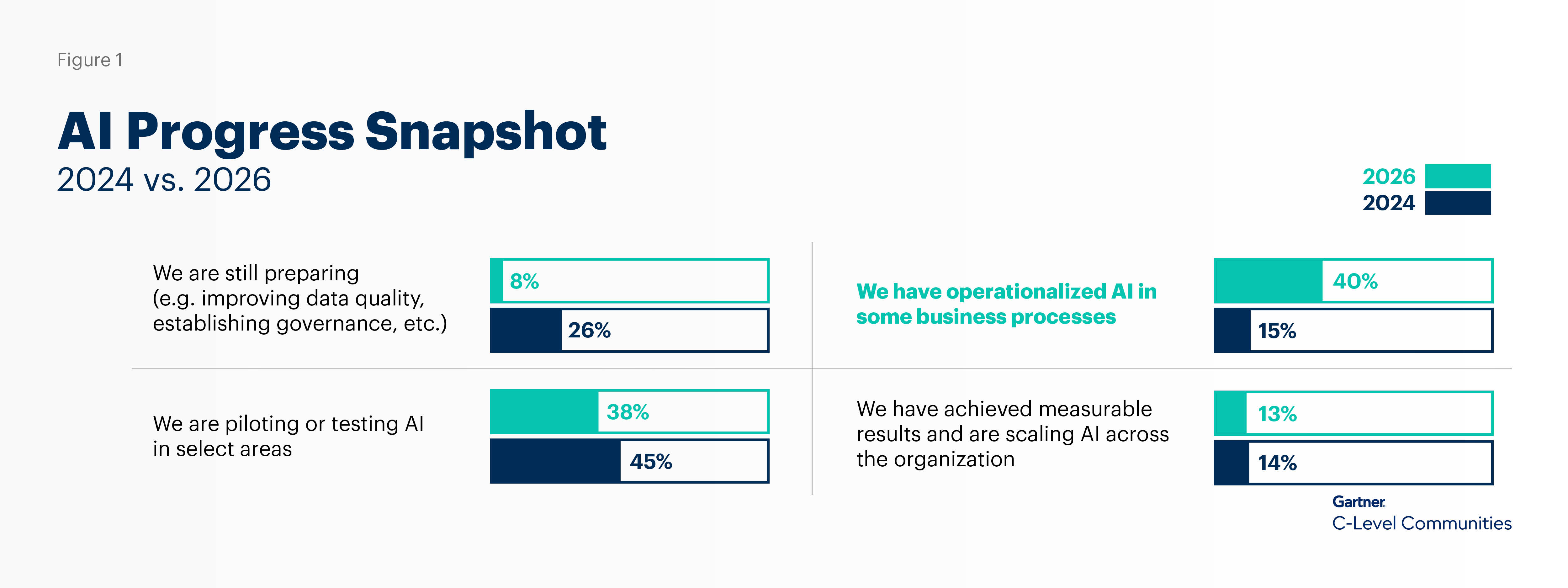
Organizations continue to make steady progress in AI maturity. Most have moved beyond the preparation phase and are now focused on piloting, testing, and operationalizing AI initiatives. Forty percent of organizations report that they have operationalized AI in selected business processes, while another 38% are actively piloting or testing AI in specific areas. Only 8% remain in the preparation phase, concentrating primarily on foundational capabilities such as data quality, governance, and infrastructure.
Compared with our survey from 2024, this represents a significant shift. Fewer organizations describe themselves as "still preparing," while a greater share have successfully moved AI into production environments. Yet despite two years of rapid investment and experimentation, enterprise-wide scale remains limited. Only a small percentage of organizations report scaling AI broadly across the business, highlighting the persistent challenge of translating successful pilots into widespread organizational adoption.
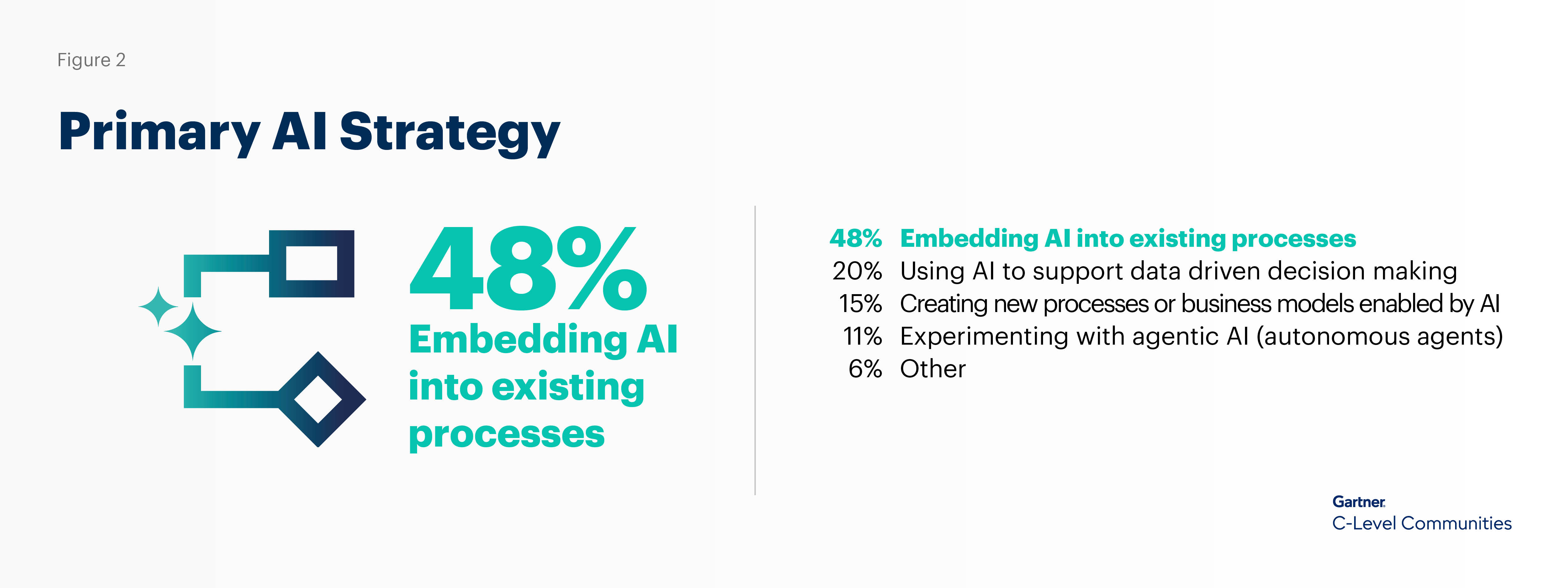
When asked about their primary AI strategy, most executives said they are focusing on embedding AI into existing workflows and business processes rather than redesigning operations from scratch. Interest in agentic AI is growing, but adoption remains relatively nascent. CIOs, in particular, described taking a multifaceted approach, with different business units progressing at different stages of maturity. As one CIO explained, “We’re partnering with business units to reimagine processes to leverage AI effectively in each area.”
Notably, qualitative responses suggest that organizations are not viewing these strategies as mutually exclusive. Many reported pursuing a dual approach – embedding AI into existing processes while simultaneously creating new AI-enabled ways of working – reflecting a pragmatic focus on driving value today while preparing for broader transformation tomorrow.
Trend 2: AI Governance, Data, and Talent Gaps Continue to Limit AI Scale
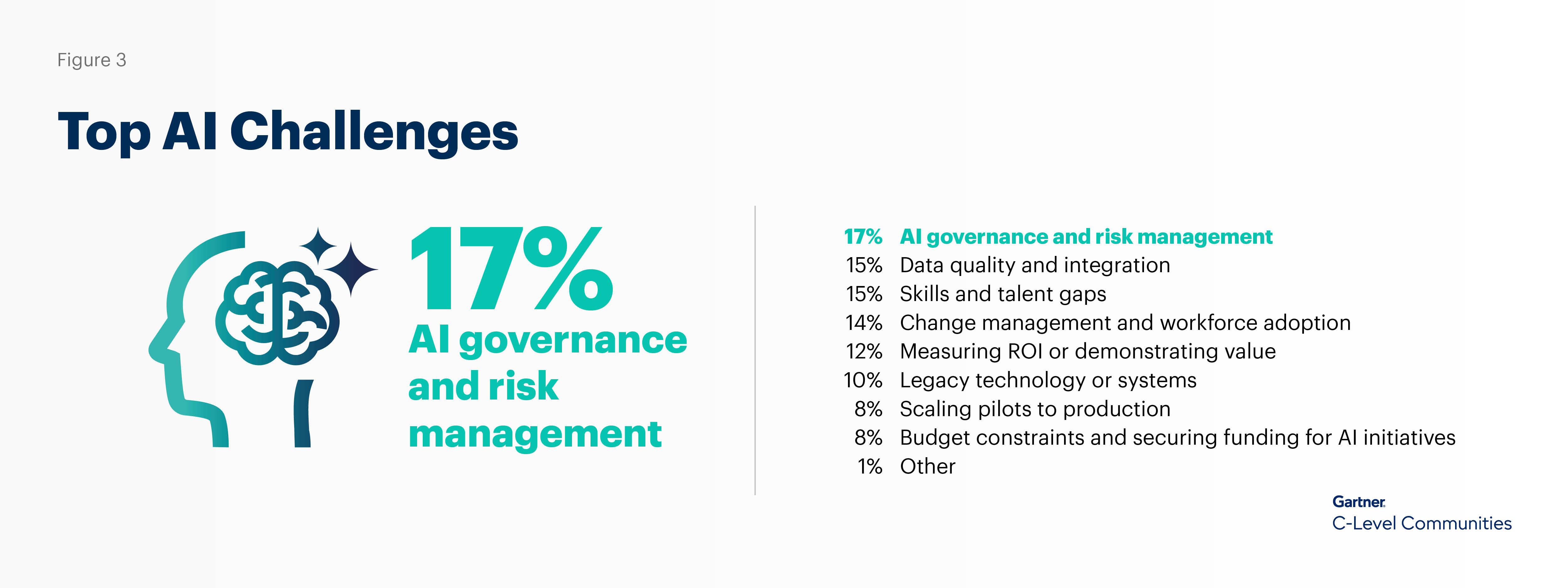
The greatest barriers to AI scale are no longer questions of whether organizations should adopt AI, but how they can do so responsibly and effectively. While organizations are making progress in operationalizing AI, the path to enterprise-scale adoption remains constrained by three persistent challenges: AI governance (17%), data quality (15%), and talent and skills gaps (15%).
These findings align closely with CIO feedback, where leaders repeatedly pointed to three barriers:
- AI Governance, Risk, and Compliance: Establishing robust oversight frameworks while balancing innovation and risk.
- Data Quality and Integration: Addressing fragmented data environments, legacy systems, and inconsistent data quality.
- Skills Gaps and Workforce Readiness: Improving AI literacy, upskilling employees, and overcoming limited internal capacity.
When asked how they are addressing these challenges, CIOs described approaches focused on building foundational capabilities, while continuing to advance AI initiatives:
- AI Governance: Building Trust While Managing Risk
With governance emerging as the top challenge, many CIOs emphasized the importance of establishing clear structures and controls that enable responsible innovation rather than slowing progress. As one CIO explained:
"We are working to put in the right governance structure to manage risk and still enable the right AI use cases via pilots and then full scale. The barrier is not there; it's just a plan to execute in a way that builds confidence and doesn't expose the business to too much risk overall."
Despite governance and risk concerns, CIOs generally expressed moderate confidence in their ability to oversee advanced AI systems. Nearly half (48%) said they are somewhat confident in their organization's ability to manage and govern AI, while 9% reported being very confident. However, confidence is far from universal: 23% remain neutral, and 20% report low confidence, underscoring the need for continued investment in governance capabilities as AI adoption expands.
- Data Quality and Integration: Modernizing Foundations for AI Success
This remains a fundamental obstacle to achieving AI at scale. Many organizations continue to struggle with disconnected systems, outdated infrastructure, and the complexity of bringing enterprise data together in a secure and usable way. One CIO described their approach:
"We’re securely integrating various disparate data sources to modernize legacy systems securely – starting with small, expanding use cases to demonstrate wins and build momentum."
This measured approach reflects a broader trend among organizations that are prioritizing incremental progress and early business outcomes while building the data foundations required for future scale.
- Talent: The Most Discussed Challenge
Although governance and data quality ranked slightly higher quantitatively, talent and workforce readiness generated the greatest volume of written feedback from CIOs, suggesting it may be the issue receiving the most immediate attention from technology leaders. Many organizations are balancing the need to accelerate AI adoption with the reality that internal skills and capacity have not yet caught up with business demand:
"We’re leveraging external resources to build and integrate GenAI capabilities that must eventually be enhanced and maintained by internal staff, who we have not hired or trained yet."
"The main barriers are organizational readiness and cross-functional coordination. We are investing in training and AI literacy across both IT and business functions to support adoption."
These comments highlight that workforce readiness extends beyond technical expertise. Successful AI adoption increasingly depends on business engagement, change management, and cross-functional collaboration.
Several CIOs also raised a broader concern – the gap between AI expectations and organizational realities. Respondents frequently described AI as "over-hyped," noting that inflated expectations can create alignment challenges, complicate prioritization efforts, and make it difficult to demonstrate value at the pace executives anticipate.
As one CIO explained, “It's very easy to blow AI projects into an impossible scope. The path we've seen to success is to get the smallest piece of the solution working and then iterate and manage risk at each iterative piece.”
Others emphasized that realizing value from AI requires business transformation as much as technology deployment. Another CIO shared, “Creating value from AI requires changes in business processes, and changing the way a business operates is always challenging. We are emphasizing the importance of process reengineering and active ownership of change by executives.”
These responses suggest that many CIOs view today's barriers as challenges to be managed rather than reasons to slow investment.
The honest answer is that the barriers are real but solvable. We're not waiting for a perfect environment. We're building the right foundation now so that when we scale, we scale responsibly. The organizations that do this carefully will be ahead. The ones that either over-restrict or under-govern AI will both lose.
Trend 3: Executive Concerns Around AI Are Easing as Adoption Matures
Executive concerns surrounding AI remain centered on security, privacy, and governance, but the intensity of these concerns has decreased markedly over the past two years. This suggests that organizations are becoming more comfortable managing AI within existing frameworks.
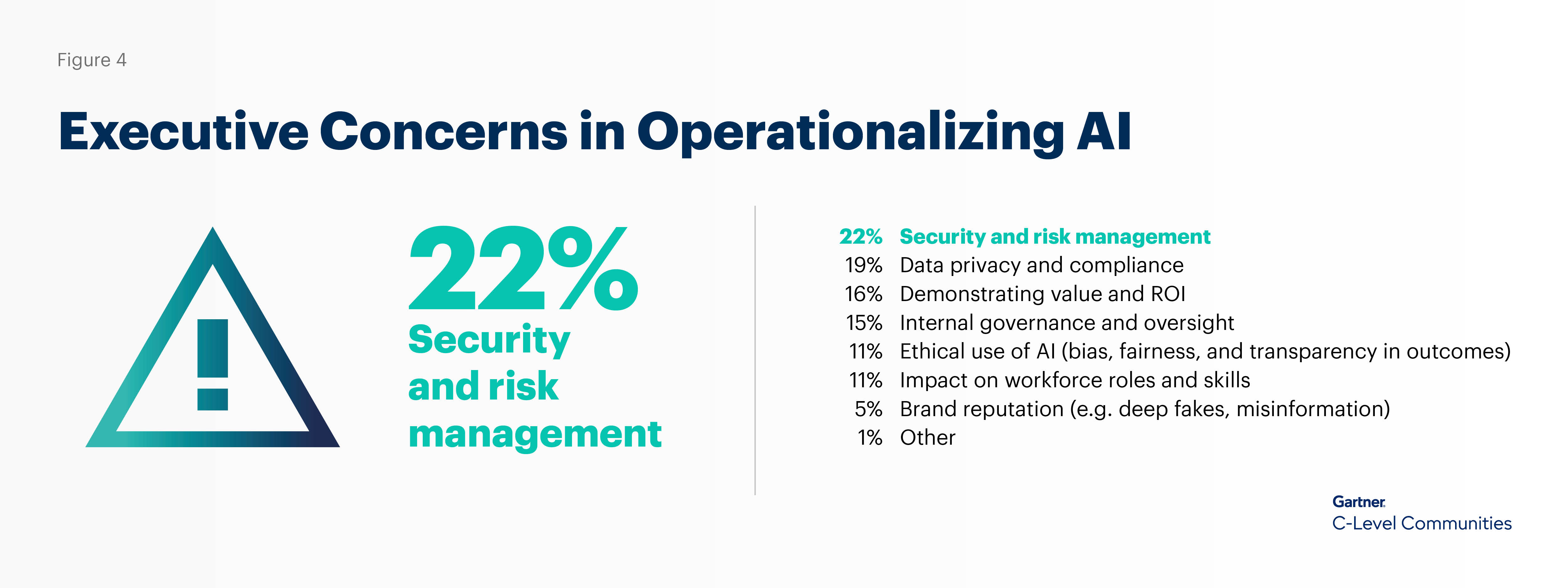
Security and risk management remains the leading concern among executives, cited by 22% of respondents. However, this represents a substantial decline from 2024, when nearly four in five executives (79%) identified it as a top issue. Similar declines were observed across other risk-related categories. Concern about data privacy and compliance dropped from 73% to 19%, while concern around internal governance and oversight fell from 71% to 15%.
As some risks become more manageable, executives are increasingly focused on realizing business value and navigating organizational change. Demonstrating measurable value and ROI, a new addition to the survey, quickly became the third most-cited concern (16%), reflecting growing pressure to translate AI experimentation into tangible business outcomes.
Trend 4: The Human Factor – AI Is Reshaping Work More Than Workforce Size
Despite ongoing concerns in the market about AI-driven job loss, most organizations are not seeing significant workforce reductions. No respondents reported a significant decrease in workforce size, and only 5% reported a moderate reduction. Instead, the impact of AI is being felt through changes in how work is performed. While 36% report no significant workforce changes to date, 20% have shifted roles and responsibilities, and 14% have created new roles. Another 24% say it is still too early to determine AI's long-term impact.
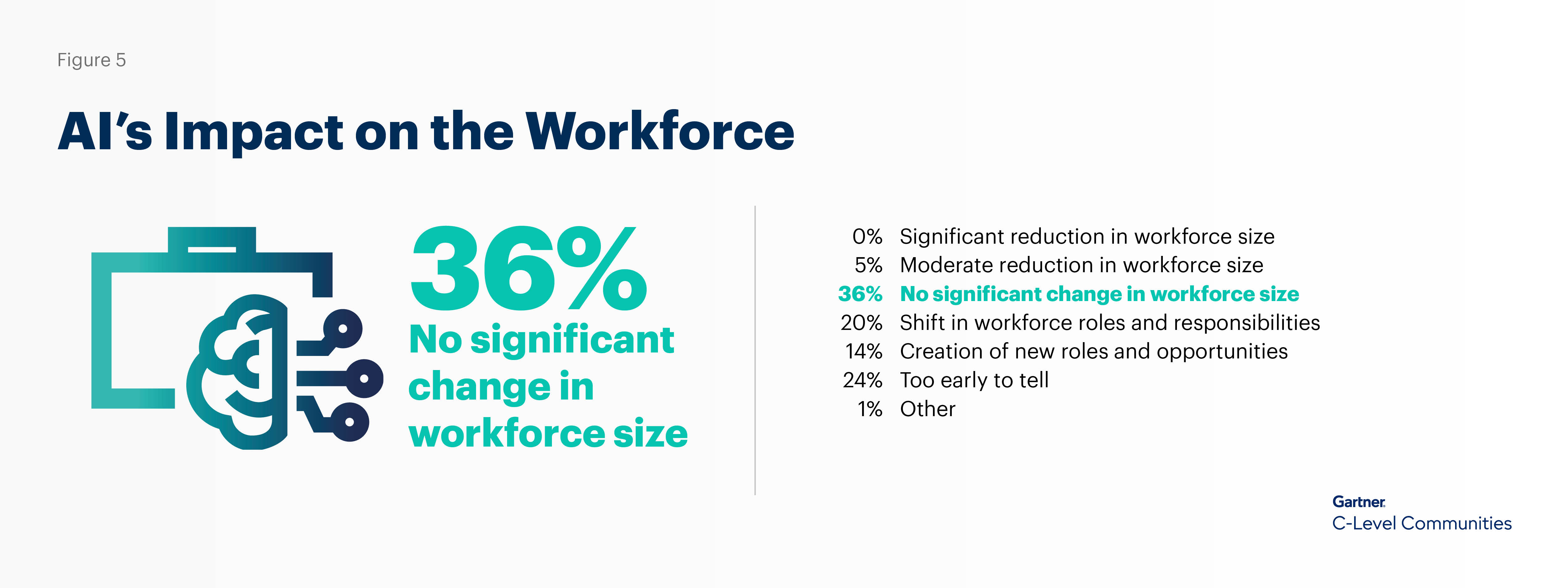
The findings suggest that organizations are using AI to increase productivity and augment employees rather than replace them. Among CIOs specifically, technology leaders described reallocating time away from repetitive, manual work and toward higher-value activities. Many also emphasized that AI is helping their organizations scale without adding headcount. Here are a sample of their responses:
Reallocation of time spent on quality and deeper assessments instead of on data gathering.
We’re reallocating human-performed effort and attention from repetitive tasks.
AI is to help us scale without reducing the workforce, but also not increasing the workforce. We have a strong commitment to our people and communities and do not lay off our workforce ever.
It allows for better focus on core responsibilities – a reduction of time-leeching work. Higher satisfaction.
Trend 5: Agentic AI Emerges as the Next Frontier for Enterprise AI
While most organizations remain focused on productivity gains and workflow automation, interest in more advanced AI capabilities – particularly agentic AI – is accelerating. When asked which advanced AI capabilities they are prioritizing, executives most frequently cited agentic AI, productivity enhancement, and AI-driven decision support.
Agentic AI is also emerging as a key area of investment as organizations look beyond copilots and chatbots toward autonomous agents that can orchestrate tasks, automate workflows, and support business processes across functions. Today, more than four in ten (44%) of organizations are exploring agentic AI use cases, 30% are piloting solutions in select areas, and 9% have already operationalized agentic AI within business processes.
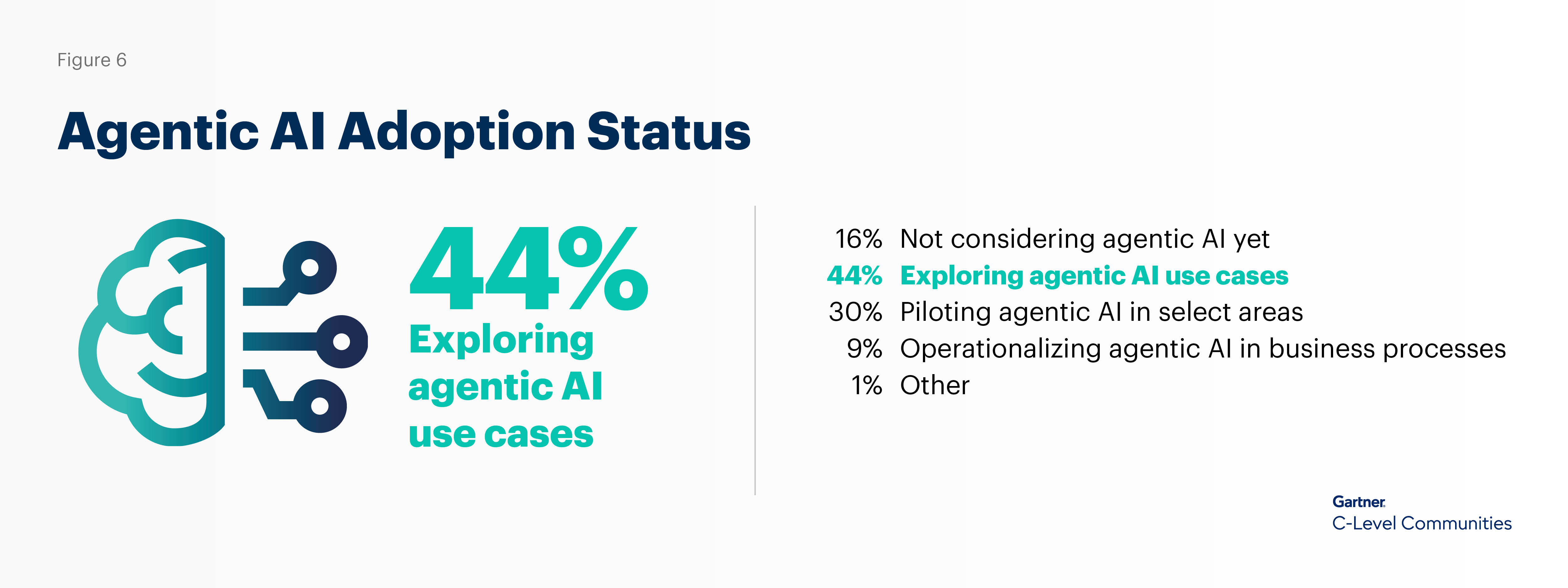
CIO comments suggest that many view agentic AI as a foundational capability for future transformation rather than simply another technology investment. As one CIO explained, “We are building an agentic infrastructure as an enabler for the future architecture of our agentic solutions.”
Another CIO described balancing near-term AI initiatives with longer-term agentic ambitions, stating, “We’re prioritizing use cases to accelerate current business goals via GenAI and ML capabilities, while preparing for transformative use cases that will change how the organization delivers services through GenAI, ML, Agents, Agentic AI and Reasoning Model.”
Several CIOs also highlighted practical applications already underway, including ERP integration and business process automation: “Using agentic AI capabilities within our ERP (vendor supplied) and developing the internal capability to develop agents.”
While operational deployments remain limited, organizations increasingly see agentic AI as the next phase of AI maturity.
We see agentic AI as a huge unlock for our company's products and services to reach a market that currently is not addressable.
Conclusion
The findings from this year's survey show that AI has entered a new phase of enterprise adoption. Organizations have largely moved beyond experimentation and are increasingly focused on operationalizing AI, embedding it into workflows, and laying the groundwork for broader transformation. At the same time, governance, data readiness, workforce capabilities, and change management remain critical barriers to scaling AI successfully.
Perhaps most notably, executive concerns about AI are evolving, and leaders are increasingly focused on demonstrating business value, improving productivity, and preparing their organizations for the next wave of innovation – including agentic AI. The data also suggests that AI's impact on the workforce is transformative, with organizations using AI to augment employees, redesign work, and create new opportunities rather than drive large-scale workforce reductions.
Among all C-Level roles surveyed, CIOs are the most optimistic about AI's future impact. Ninety-two percent report a positive outlook on AI, compared with just 6% who were neutral and 2% who expressed a negative view. This optimism reflects the growing confidence of technology leaders that, while the challenges of AI adoption are real, the long-term opportunities far outweigh the risks.
As organizations continue their AI journey, most successful CIOs aren't navigating AI alone. Learn how joining Gartner CIO Communities enables you to engage with a trusted network of technology executives sharing real-world experiences, lessons learned, and strategies for AI-driven transformation.
If you are also a member of Gartner C-Level Communities, sign in to find your next community gathering.
Based on 750 responses to Gartner C-Level Communities’ Community Pulse Survey, June 2026.
By CIOs, For CIOs®
Find your local community and explore the benefits of becoming a member.