Over the past several years, Gartner C-Level Communities has tracked how executive attitudes toward AI have evolved, from the initial excitement surrounding generative AI to the realities of early enterprise adoption.
This year's survey of 750 C-Level executives within our communities examines the next phase of that journey: operationalizing AI at scale. As organizations move beyond pilots and isolated use cases, leaders are shifting their focus toward embedding AI into business processes, demonstrating measurable business value, and building the organizational capabilities required for long-term success.
This report highlights five significant trends shaping how executives are navigating AI adoption today. Together, these findings reveal an executive community that is increasingly focused on execution, scalability, and sustainable business impact.
Trend 1: AI Moves Beyond Experimentation to Enterprise Execution
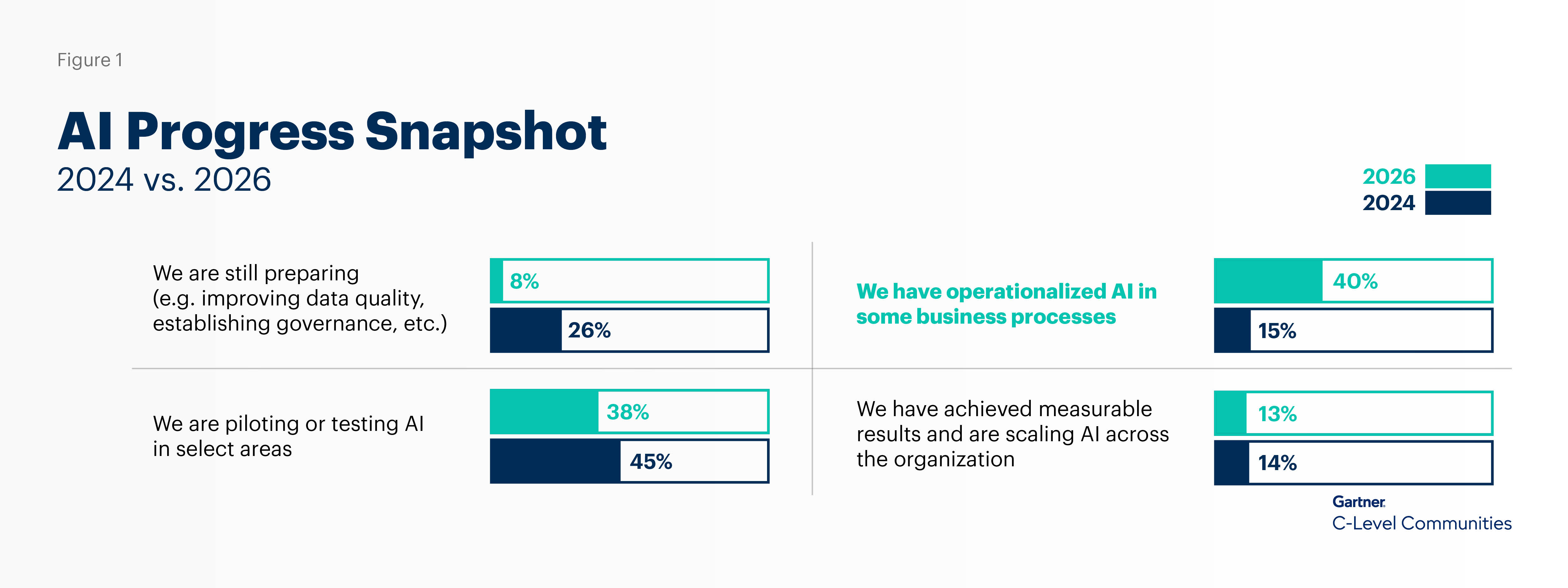
Organizations are steadily advancing in their AI maturity, with most now moving beyond preparation and exploration toward piloting, testing, and operationalizing AI initiatives. According to the survey, 40% of executives report their organizations have already embedded AI into select business processes, while another 38% say they are actively running pilots or tests in specific areas. Only 8% of community members say their companies remain in the preparation stage, focused primarily on foundational elements such as data quality, governance, and infrastructure.
Compared to previous years, this represents a meaningful shift. Fewer organizations describe themselves as "still preparing," and more are successfully moving AI into production environments.
Nearly half of executives (48%) report focusing primarily on embedding AI into existing workflows and business processes, compared to just 15% who are building entirely new processes from the ground up. As one executive explained:
First and foremost, we’re revisiting existing processes and standards, eliminating waste and ensuring the foundations are strong before we scale AI.
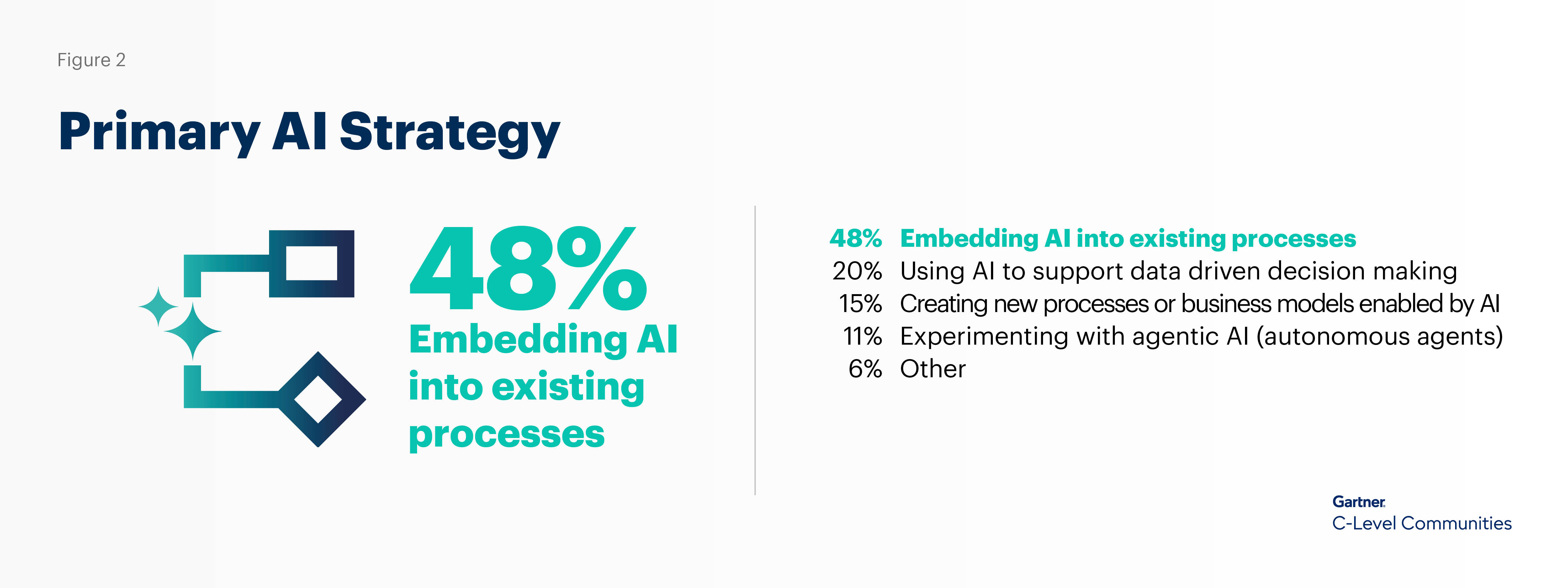
Qualitative responses suggest that most organizations are taking a multifaceted approach, combining efforts to integrate AI into existing operations, redesign workflows, and explore new AI-enabled business models. Several executives also noted that adoption rates vary significantly across business units and functions. As one executive stated:
We’re partnering with business units to reimagine processes to leverage AI effectively in each area.

Trend 2: Talent Gaps, Data Quality & AI Governance Are Limiting Scale
While organizations are making meaningful progress in AI adoption, scaling successful initiatives remains difficult. Executives identified three barriers that continue to slow broader implementation:
- AI Governance, Risk, and Compliance
- Data Quality and Integration
- Skills and Workforce Readiness
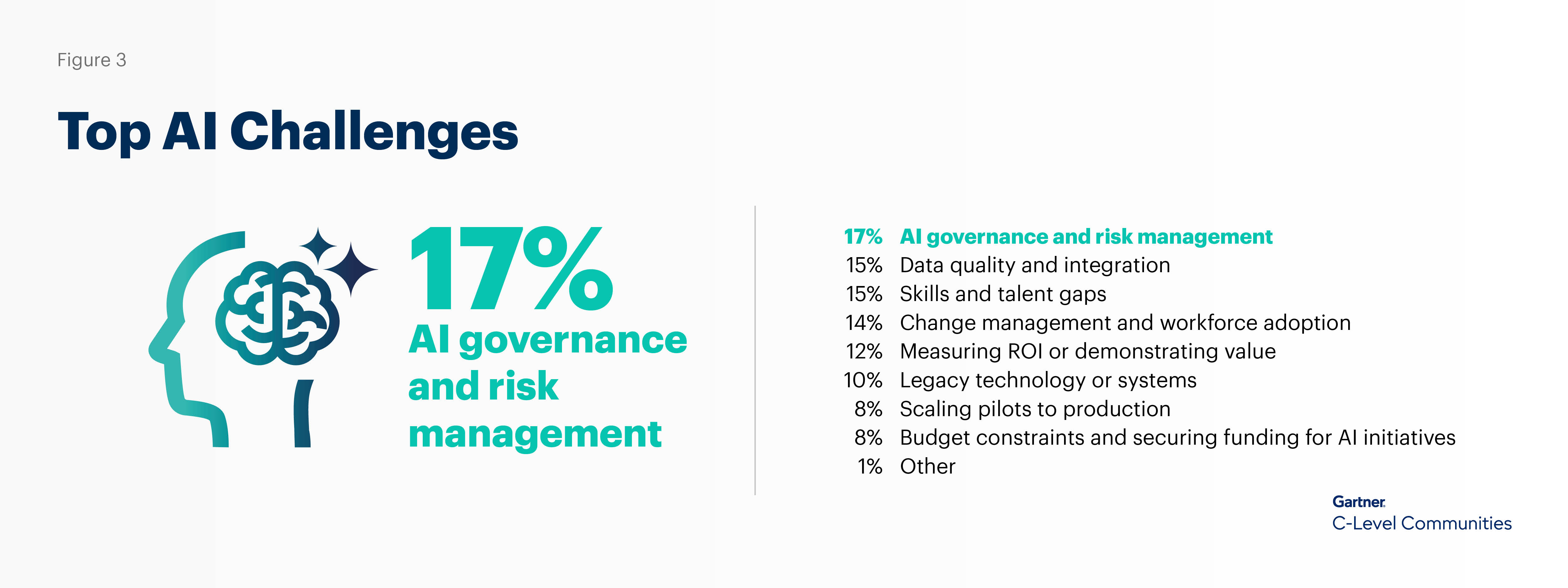
Notably, these challenges are less about the AI technology itself and more about the organizational capabilities required to support it at scale. When asked how they are addressing these barriers, executives consistently pointed to investments in governance frameworks, data modernization, and workforce development.
- AI Governance: Building Trust While Managing Risk
Governance emerged as the most frequently cited challenge to scaling AI. Executives recognize that governance frameworks are critical for managing risk, maintaining stakeholder trust, and complying with evolving regulatory requirements.
However, executives also acknowledge the tension between maintaining appropriate oversight and moving quickly enough to capture business value.
We are working to put in the right governance structure to manage risk and still enable the right AI use cases via pilots and then full scale. The barrier is not there; it's just a plan to execute in a way that builds confidence and doesn't expose the business to too much risk overall.
Security and risk governance means our pace is slower than we would like, and fragmented legacy tools and systems make progress challenging. We have to pilot and adapt.
The absence of a governance framework is the main barrier, both upstream and downstream.
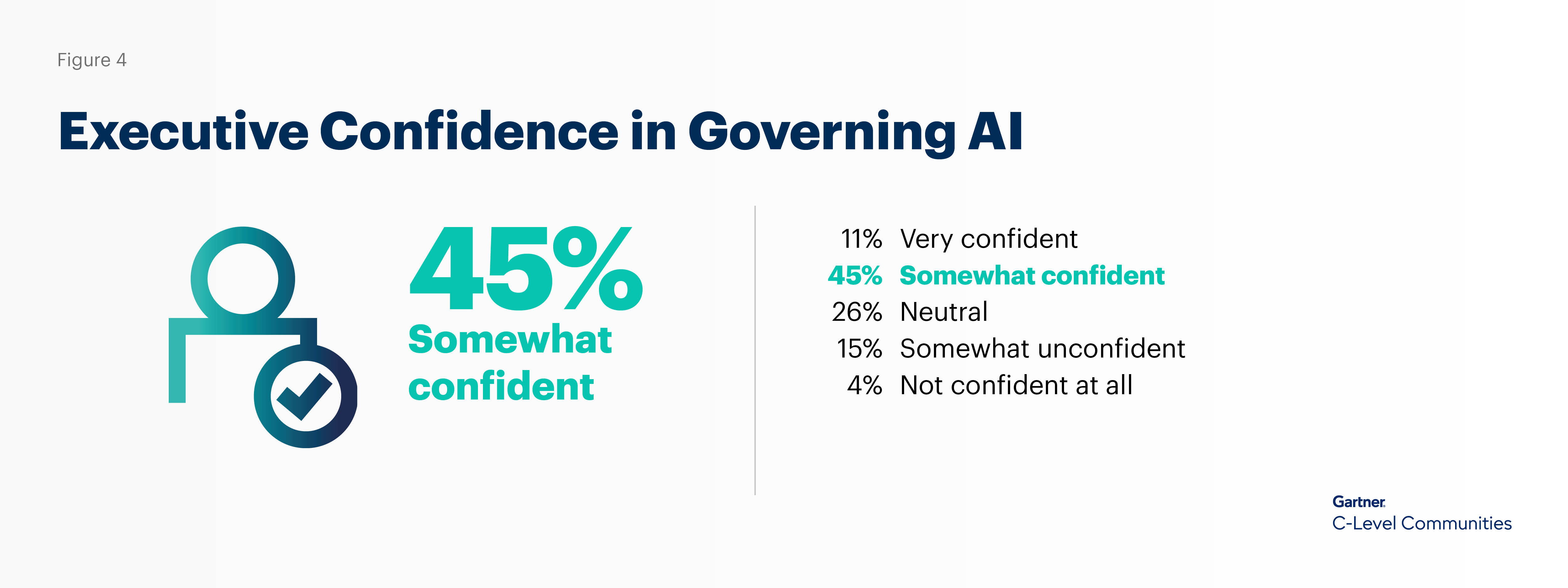
Despite these challenges, confidence is growing. More than half of executives (56%) report confidence in their organization's ability to govern AI effectively. Still, nearly half remain neutral or report low confidence, highlighting significant room for maturity.
- Data Quality and Integration: Building the Foundation for Scale
Data remains the foundation of successful AI implementation. Yet fragmented systems, inconsistent data quality, and legacy technology environments continue to constrain adoption efforts.
We are normalizing data and trying to determine how best to scale data without replicating data or creating huge data movement costs.
We’re integrating various disparate data sources to modernize legacy systems securely – starting with small, expanding use cases to demonstrate wins and build momentum.
Executive responses suggest that many organizations are taking a pragmatic approach, focusing on incremental improvements that strengthen data accessibility and quality while laying the groundwork for larger-scale deployments.
- Workforce Readiness: Preparing Employees for AI-Powered Work
Although governance and data challenges ranked slightly higher quantitatively, workforce readiness generated the greatest volume of qualitative commentary.
Executives repeatedly emphasized the challenge of aligning workforce capabilities with growing AI ambitions. Many organizations are investing in AI literacy, role-based training, and capability-building initiatives, while others continue to leverage external expertise as they develop internal skills.
We’re leveraging external resources to build and integrate GenAI capabilities that must eventually be enhanced and maintained by internal staff, who we have not hired or trained yet.
Workforce readiness. We’re elevating associate capabilities through training, Build-A-Thons, assessing team- and role-specific use case scenarios, as well as embedding AI literacy as a required competency across the enterprise.
The main barriers are organizational readiness and cross-functional coordination. We are investing in training and AI literacy across both IT and business functions to support adoption.
Trend 3: AI Concerns Are Expanding Beyond Risk Management to Business Value
While security, privacy, and governance remain important considerations, executives report significantly lower levels of concern than they did in previous community surveys. Concerns about security and risk management declined from 79% in 2024 to 22% in 2026. Similarly, concerns around data privacy and compliance fell from 73% to 19%, while governance and oversight concerns dropped from 71% to 15%.
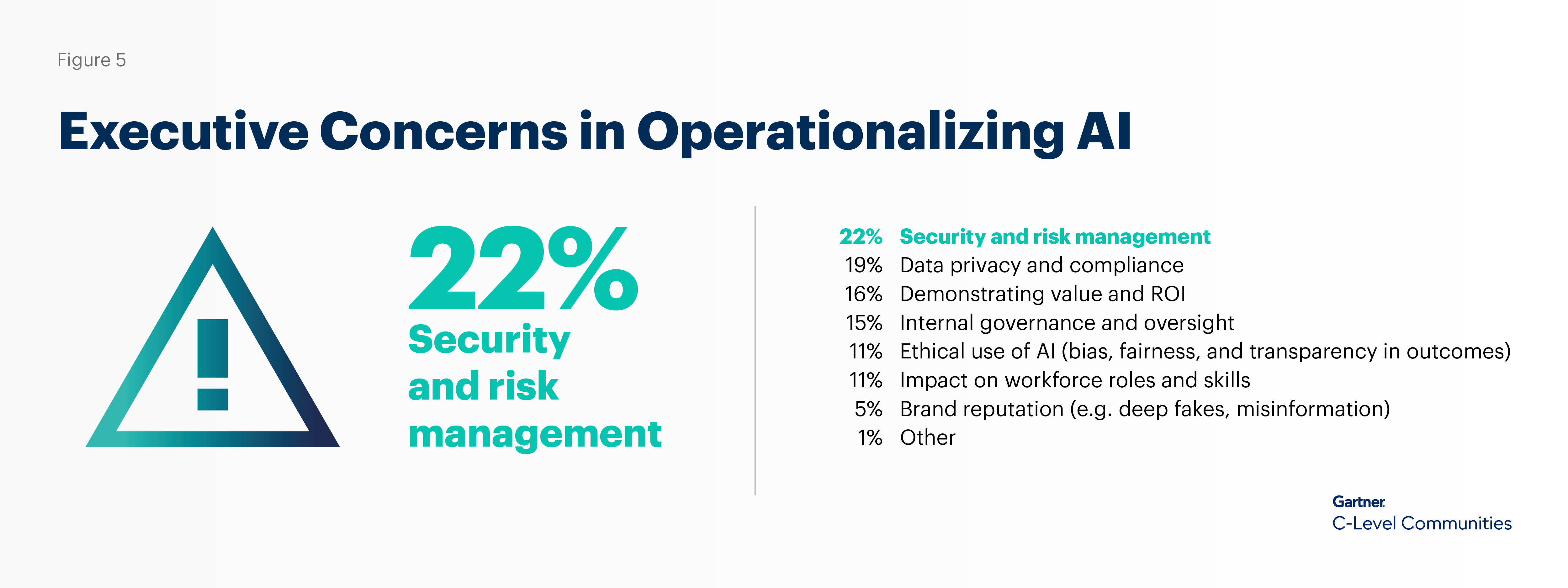
This shift does not suggest that these risks have disappeared as it's still the top concern in the survey. Rather, executives appear increasingly confident in their ability to manage them as their organizations gain practical experience implementing AI. As one executive noted:
The honest answer is that the barriers are real but solvable.
At the same time, attention is shifting toward business outcomes. Measuring ROI emerged as the third most-cited concern (16%), reflecting growing pressure to demonstrate tangible results from AI investments.
The findings suggest that executive conversations are evolving. Two years ago, the dominant question was whether AI could be adopted safely and responsibly. Today, many leaders are focused on how to scale AI successfully and generate business value.
Trend 4: AI Is Reshaping Work More Than It Is Reducing Jobs
While skill gaps and workforce readiness remain key challenges, executives report that AI's impact is being felt more through changing ways of working than through workforce reductions.
Despite widespread public discussion about AI-driven job loss, survey respondents reported little evidence of this. No executives surveyed reported substantial workforce reductions, and only 5% indicated a moderate decrease in workforce size.
Instead, AI is driving changes in roles, responsibilities, and workflows. Twenty percent of executives reported modifications to existing roles, while 14% said AI adoption has created entirely new positions within their organizations.
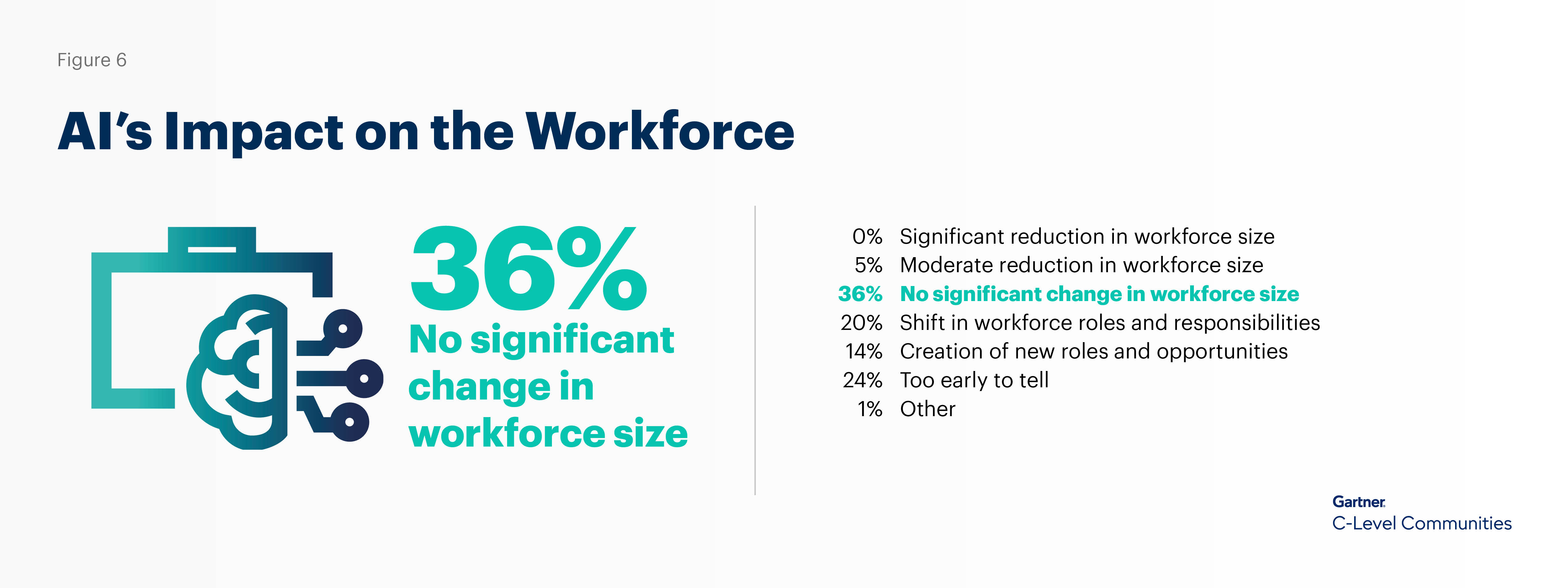
The findings suggest that AI is serving primarily as a force multiplier for employees rather than a replacement for them. Organizations are using AI to automate repetitive work, streamline processes, and allow employees to focus on higher-value activities.
We’re reallocating human-performed effort and attention from repetitive tasks.
AI is to help us scale without reducing the workforce, but also not increasing the workforce. We have a strong commitment to our people and communities and do not lay off our workforce ever.
It allows for better focus on core responsibilities – a reduction of time-leeching work. Higher satisfaction.
Trend 5: Agentic AI Gains Momentum Across the Enterprise
As organizations become more comfortable embedding AI into workflows and business processes, many are beginning to explore more autonomous applications that can act on behalf of employees rather than simply assist them. Among advanced AI capabilities, agentic AI emerged as one of the most frequently cited areas of executive interest.
Today, 44% of executives report their organizations are exploring agentic AI use cases, 30% say they are piloting solutions in specific areas, and 9% have already operationalized agentic AI within business processes.
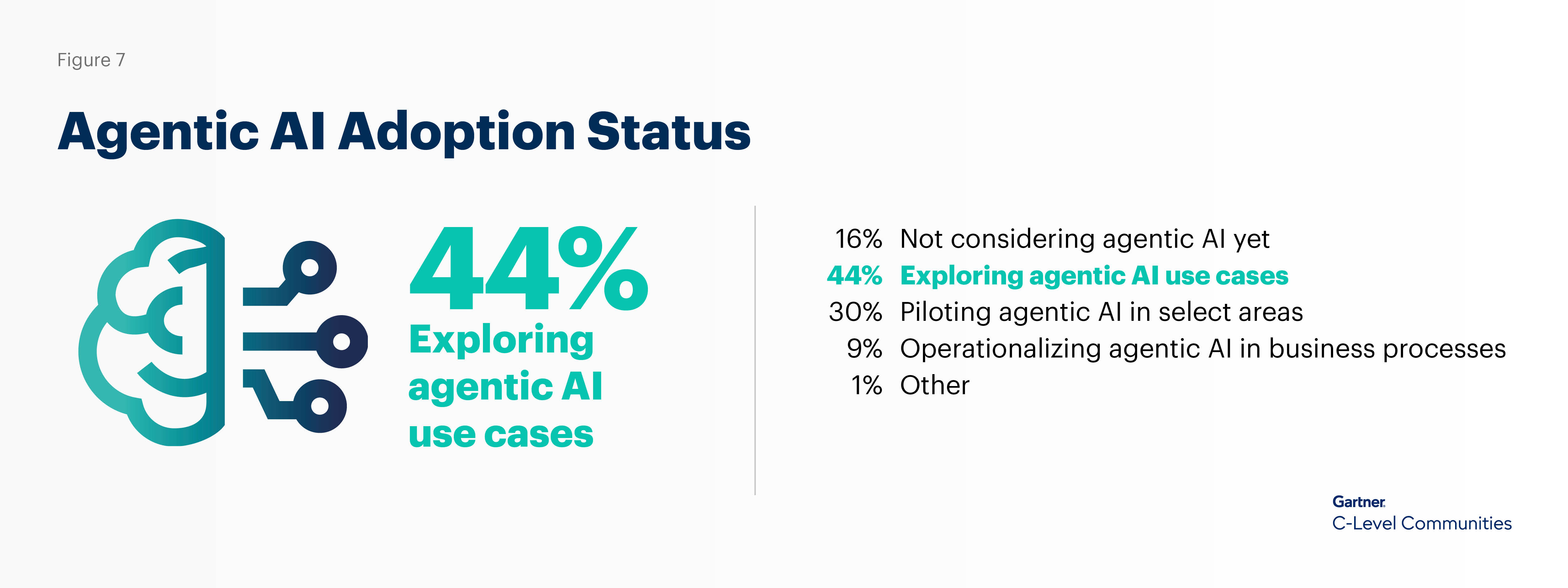
Comments indicate that executives are evaluating agentic AI across a wide range of functions, including process automation, software development, finance, operations, customer support, analytics, and workforce management. Many are focused on reducing repetitive work, streamlining workflows, connecting systems, and enabling new levels of operational efficiency.
Using Agentic AI like a new graduate. Automating repetitive processes.
Utilizing Agentic AI in many support service functions as well as piloting this work into the healthcare operations.
Several executives also described efforts to embed agentic capabilities within existing technology environments, including ERP platforms and enterprise workflows, while others are investing in the foundational infrastructure required to support broader adoption.
Agentic AI capabilities within our ERP (vendor supplied) and developing the internal capability to develop agents.
We are building an agentic infrastructure as an enabler for the future architecture of our agentic solutions.
While most organizations remain in the exploration or pilot stages, the volume and variety of responses suggest that executives increasingly view agentic AI as an important next step in their AI journey. As one executive highlighted, “We see agentic AI as a huge unlock for our company's products and services to reach a market that currently is not addressable.”
Conclusion
Artificial intelligence has entered a new phase of enterprise adoption. The findings from this year's community survey suggest that the conversation has shifted decisively from experimentation to execution.
Across roles and industries, executives are embedding AI into business processes, transforming workflows, and increasingly focusing on measurable business outcomes. At the same time, the most significant obstacles to scale are no longer primarily technological. Governance maturity, data readiness, and workforce capabilities have emerged as the critical factors determining whether organizations can move successfully from isolated pilots to enterprise-wide impact.
The growing interest in agentic AI further signals that organizations are already preparing for the next phase of adoption. While many remain in the early stages of exploration, executives are actively evaluating how more autonomous AI capabilities can improve operations, enhance decision-making, and unlock new opportunities for growth.
Taken together, these findings paint a picture of an executive community that is increasingly confident, pragmatic, and focused on results.
If you are a CIO, CISO, CHRO, CDAO, CFO, or CSCO navigating AI transformation, Gartner C-Level Communities provide a unique opportunity to connect with peers facing similar challenges. Apply to join Gartner C-Level Communities to exchange insights, learn from real-world experiences, and explore practical strategies for leading AI adoption and delivering business value.
If you are already a member of Gartner C-Level Communities, sign in to find your next community gathering.
Based on 750 responses to Gartner C-Level Communities’ Community Pulse Survey, June 2026.
By CIOs, For CIOs®
Find your local community and explore the benefits of becoming a member.