In 2026, the pace of new disruptions facing organizations has only intensified, as technological innovation, evolving workforce expectations, and ongoing economic and geopolitical volatility continue to reshape the HR landscape. Despite these complexities, CHROs remain steadfast in their commitment to strategic priorities – developing resilient leaders, leveraging AI and HR technology for business impact, and embedding change management into everyday operations.
This year’s Leadership Perspective Survey captures these themes, with 750 CHRO community members sharing their top priorities, goals, and challenges for the year ahead. Their insights, along with findings from hundreds of follow-up conversations, offer a clear view into the evolving role of the CHRO and the critical issues shaping the future of work.
In this report, we explore the leading priorities for CHROs in 2026, both within the HR function and across the broader enterprise.
Top Functional Priorities for CHROs
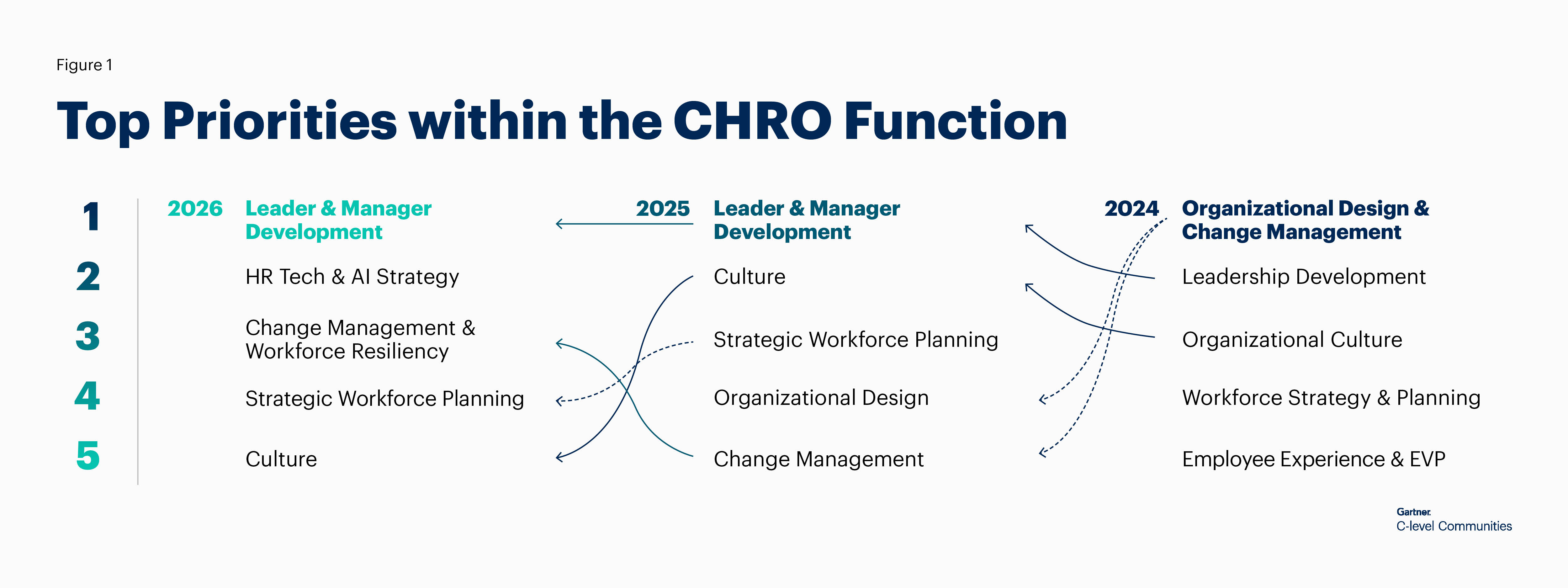
For the second year in a row, “Leader & Manager Development” stands as the foremost priority for CHROs in 2026. As organizations face ongoing change and the workforce adapts to the growing influence of AI, HR executives are prioritizing the development of managers at all levels to ensure they can lead with adaptability, confidence, and resilience during uncertain times.
A significant newcomer to the top five is “HR Tech & AI Strategy,” which has climbed to the second highest priority for CHROs this year. HR leaders are spearheading AI and digital innovation within their business units, while also assessing AI’s broader impact on workforce structure, role design, and the growing need for upskilling.
At the same time, “Change Management & Workforce Resiliency” has advanced to the third most critical priority for 2026, up from fifth last year. This shift highlights an increased emphasis on supporting organizations and employees as they navigate constant change and disruption, with a heightened focus on resiliency in the workforce.
“Strategic Workforce Planning,” which held the third position in 2025, has slipped slightly but remains a vital focus area as organizations work to align talent strategies with long-term business goals. Completing the top five is “Culture,” which has declined modestly from its previous ranking as the second most important priority. HR leaders continue to reshape organizational culture to keep pace with evolving business needs and rising employee expectations.
Below, we explore the top three priorities for CHROs more in depth, highlighting the primary goals and challenges they face within each area.

Building Resilient Leaders at All Levels
In today’s climate of constant disruption, the ability to lead with agility has never been more critical. CHROs are prioritizing the development of resilient, adaptable leaders who can guide their teams through uncertainty, foster a culture of flexibility, and maintain organizational competitiveness. As one HR executive observed, “It’s a constant evolution of what you need a great leader to be. The biggest gaps we see are in change leadership – the ability to deal with technological change and global change.”
Gartner insights underscores the urgency of this focus, finding that leaders who “routinize, not just inspire, change” can drive a threefold increase in healthy change adoption among employees. Yet, only 32% of leaders globally are currently able to achieve this, highlighting a significant opportunity for improvement.
As technological advancement and AI accelerate, leadership expectations are evolving rapidly. In response, many organizations are adopting innovative approaches to development. One CHRO highlighted how they have implemented “reverse mentoring,” where junior employees coach senior leaders on technology and AI. This practice is helping to foster new mindsets and bridge generational gaps. “It’s been amazing embracing new mindsets and generational perspectives,” they shared.
Importantly, CHROs are taking a holistic approach to leader and manager development. They recognize that leadership extends beyond the executive suite, as frontline and mid-level managers are pivotal in shaping culture, driving engagement, and achieving strategic goals. By prioritizing development, continuous learning, and robust support at all levels, CHROs are strengthening their leadership bench, supporting succession planning, and equipping their organizations to thrive in the face of ongoing change.
In the survey, CHROs identified their top goals and challenges related to leader and manager development. Their main objective is to develop talent and skills, closely followed by improving business outcomes, and improving employee experience. However, they also face significant obstacles, with competing priorities cited as the most pressing challenge, alongside a lack of necessary skills and resources.
Goals for Leader & Manager Development
76% Developing talent and skills
71% Improving business outcomes
47% Improving employee experience
Challenges around Leader & Manager Development
49% Competing priorities
45% Lack of skills
41% Lack of resources
To complement the survey findings, we conducted follow-up conversations with CHROs to gain deeper insight into their evolving priorities. Here are a few of their perspectives:
We’re ruthlessly prioritizing leaders, being very strict about how they should behave and measuring that behavior. There are clear expectations and support available to achieve them.
For 2026, we’re shifting from rigid planning to adaptive leadership. Our strategy needs to be resilient and responsive.
Leadership development can no longer look three years out; leaders must be equipped to build capabilities for the next six months.
Balancing AI with the Human Experience
As AI and advanced HR technologies rapidly transform the workplace, CHROs are challenged to reimagine the very foundation of the HR function. By 2026, AI is expected to automate or manage half of all HR activities, presenting both opportunities and complexities for HR leaders. The focus is not only on adopting new tools, but on strategically integrating AI to elevate the human experience at work and drive meaningful business outcomes.
Gartner highlights the momentum behind this shift, revealing that 92% of HR leaders have taken steps to implement AI in the past six months, and by 2030, AI could augment all HR tasks and perform up to half of them. Reflecting this urgency, half of CHRO survey respondents report plans to invest in AI solutions this year.
CHROs are at various stages of their AI adoption journeys. Some shared that they are deploying custom AI bots to automate manual processes and provide self-service tools for managers. Others are rolling out mandatory AI training and emphasizing change management to address employee concerns and build confidence in new technologies.
What’s more, CHROs recognize that the impact of AI reaches far beyond efficiency gains. As Joe Hudson, Chief People Officer at LURIN, notes, “The number one thing HR leaders should be focused on is the real impact of AI over the course of the next six months, a year, two years. Not just how we can make people more efficient or how it's going to impact jobs, but also how it impacts organizational culture and how we keep the ‘human’ in human resources as we move forward.” Cara McDaniel, Chief HR & Talent Officer at Veritex Community Bank, adds, “We are the bridge that brings AI with emotional intelligence. We have to figure out how we can take away some of the drudgery of employees’ jobs, but keep the work that is fulfilling so that we have a workforce that's highly engaged. Marrying those two is going to be really important for CHROs to focus on in the next six months.”
In the survey, CHROs outlined their top goals for HR tech and AI strategy as improving processes and efficiencies, improving business outcomes, and making data-driven decisions. Challenges include a lack of skills, competing priorities, and the rapidly changing landscape.
Goals for HR Tech & AI Strategy
75% Improving processes and efficiencies
59% Improving business outcomes
56% Make data-driven decisions
Challenges around HR Tech & AI Strategy
45% Lack of skills
37% Competing priorities
35% Quickly changing landscape
CHROs shared additional perspectives on AI in the future of work:
The surest way to become obsolete is to not be proficient with AI tools. We’re striving for a balance between tech-driven solutions and human touch, especially for people leaders.
We’re readying our data foundations, addressing the need for governance and ensuring foundation levels are in good shape before putting an AI lens on HR work.
We all need to change the way we operate; we need to make AI successful. If we don't make AI work for the company, discussing the future of work is pointless.
Navigating Change and Building Workforce Resiliency
As organizations face unprecedented levels of disruption, change management and workforce resiliency have re-emerged as top priorities for CHROs. After ranking as the number one priority in 2024 and dipping to fifth in 2025, this focus is trending upward in response to the accelerating pace of transformation. HR leaders are not only guiding their organizations through change, but also equipping their workforces to thrive amid ongoing uncertainty.
Change management is no longer a one-time initiative; it has become a continuous process embedded in daily operations and leadership development. As Scott Sherman, SVP & Chief Legal & HR Officer at Sally Beauty Holdings, observes, “It’s not about change management of a specific project or task. It’s about how change is constant. You have to get yourself, your team, and then the broader organization ready for that to be the norm going forward.” This sentiment was echoed at a recent New York CHRO Community Town Hall, where one leader remarked, “Chaos is inevitable, confusion is optional,” and another added, “You cannot manage change, as it happens too fast – but you can orchestrate it.”
With change management closely tied to leader and manager development, addressing change fatigue and establishing practical routines that help employees feel grounded are essential. As one CHRO explained, “Fatigue with change is real… Managing fatigue means that you need to give people space, because not everyone is going at the same pace.”
As organizations adapt to rapid shifts in both internal and external environments, maintaining engagement and building cultural resiliency are also top of mind. Leadership teams are emphasizing honesty, authenticity, and responsiveness to employee feedback, leveraging data to continually adapt and improve.
In our survey, CHROs identified the following top goals and challenges for change management and workforce resiliency:
Goals for Change Management & Workforce Resiliency
68% Improving business outcomes
42% Improving processes and efficiencies
39% Improving employee experience
Challenges around Change Management & Workforce Resiliency
47% Company culture
46% Competing priorities
38% Employee adoption
Here are a few additional comments from CHROs on this topic:
We’ve been in the most intense period of change. This is a reset moment. We need to bring everyone together.
Change capability must be a core leadership skill. Leaders must accept constant change and learn to manage it effectively.
Cultural change is a big focus, with resiliency as a big part of that. We’re working on how to drive culture change to insulate from change.
CHROs’ Priorities Across the Enterprise
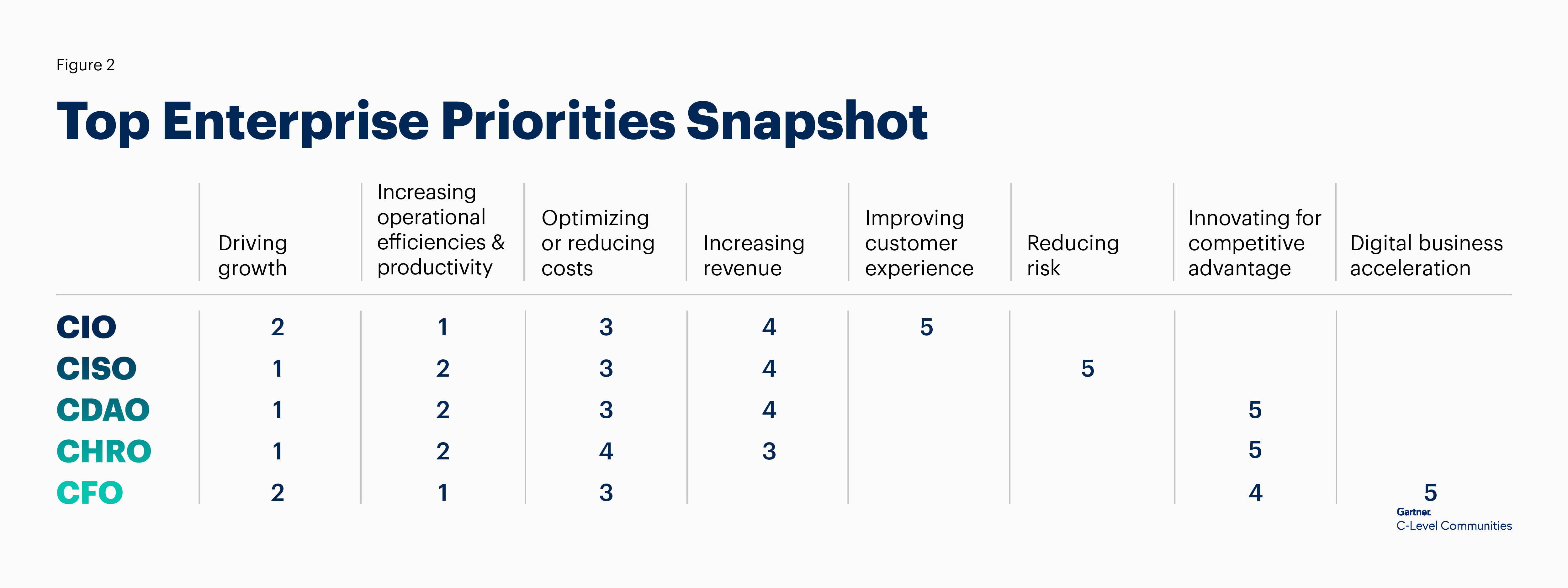
In addition to functional objectives, our Leadership Perspective Survey captures C-suite leaders’ organization-wide focus areas. For 2026, CHROs’ enterprise priorities remain closely aligned with those of their executive peers and show consistency with last year’s findings. Once again, driving growth stands out as the foremost priority for CHROs – mirroring the top focus area for CISOs and CDAOs, as well.
Increasing operational efficiency and productivity continues to be the second most important enterprise goal for CHROs, echoing the priorities of CIOs and CFOs. Alongside a sustained emphasis on increasing revenue and optimizing costs, CHROs are also turning their attention to innovation. Notably, innovating for competitive advantage appears among the top five enterprise priorities for the first time this year, taking the place of employee satisfaction and engagement, which was featured in 2025.
Ongoing turbulence in economic conditions, global affairs, and rapid advancements in AI have reinforced the C-suite’s collective focus on growth, efficiency, and innovation. The following table provides a comparative look at the leading enterprise priorities for CHROs and their C-level counterparts in 2026.
The Outlook for CHROs
The year ahead presents both challenges and opportunities for CHROs. As organizations navigate an era of unprecedented disruption, the CHRO’s role has become more central and complex than ever. Positioned as a strategic partner for enterprise transformation, CHROs are balancing the demands of rapid technological advancement, workforce evolution, and the ongoing need for organizational agility.
Leader and manager development will remain a top priority, as resilient and adaptable leaders are essential for guiding teams through uncertainty and fostering a culture of trust and high performance. Simultaneously, the integration of AI and advanced HR technologies is reshaping not only HR operations but also the broader employee experience. CHROs are uniquely positioned to ensure that technology adoption is both strategic and human-centered – leveraging AI to drive efficiency and business outcomes, while preserving the core values of empathy, engagement, and inclusion.
Change management and workforce resiliency will continue to be foundational priorities, as organizations adapt to shifting market conditions, new operating models, and evolving employee expectations. CHROs are also increasingly aligned with their C-suite peers on driving growth, boosting operational efficiency, and fostering innovation. Their ability to anticipate trends, respond to disruption, and lead with both vision and empathy will be critical to organizational success in the years ahead.
CHROs across Gartner CHRO Communities regularly connect with local peers to discuss critical priorities, share expertise, and learn from one another. To participate in a Gartner CHRO Community, apply to join, or if you are already a member, sign in to learn more and register for your upcoming community events.
Based on 750 CHRO responses from Gartner C-level Communities’ proprietary Leadership Perspective Survey, May 2026.
By CHROs, For CHROs®
Find your local community and explore the benefits of becoming a member.