In 2026, Chief Data & Analytics Officers (CDAOs) are navigating a landscape defined by rapid technological advancement, surging data volumes, and the transformative potential of generative and agentic AI. As a result, the role of the CDAO – and data and analytics function – is evolving to champion AI initiatives, accelerate AI-ready data and governance, and advance data and AI literacy across the business.
Our annual Leadership Perspective Survey captured insights from more than 600 CDAO community members, who shared their top priorities, goals, and challenges for the year ahead. Their responses, combined with findings from hundreds of follow-up conversations, reveal how CDAOs are rising to meet these heightened expectations and keep pace with innovation.
In this report, we explore the leading priorities for CDAOs in 2026, both within the data and analytics function and across the broader enterprise, offering a comprehensive view of the opportunities and challenges shaping the future of D&A leadership.
Top Functional Priorities for CDAOs
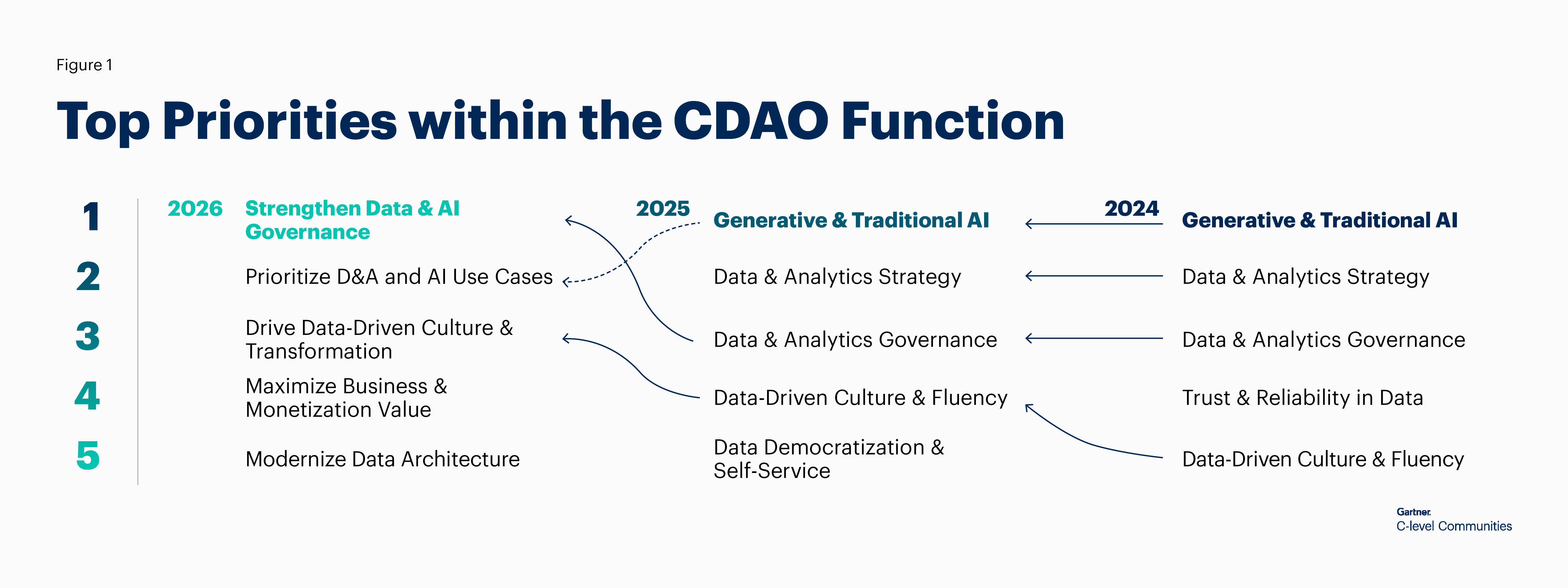
Reflecting the rapid transformation of the AI landscape, this year’s survey introduced new and refined categories to better capture CDAOs’ current priorities – moving beyond last year’s broader focus on “Traditional and Generative AI.” While data governance has always been a cornerstone for CDAOs, the priority has evolved into “Strengthen Data & AI Governance” to explicitly address the growing influence of AI. This shift propelled it to the top of the list for 2026, up from third place last year.
Another significant addition is “Prioritize D&A and AI Use Cases,” which makes its debut as the second most important priority. This underscores the pressing need for CDAOs to identify, scale, and operationalize impactful data and AI applications across the organization.
“Drive Data-Driven Culture & Transformation” holds the third spot, continuing its upward trajectory as CDAOs play an increasingly pivotal role in embedding a data-driven mindset and supporting organizational agility amid ongoing technological change.
A particularly noteworthy development in 2026 is the dramatic rise of “Maximize Business & Monetization Value,” which jumped 22 places from last year. CDAOs are under greater pressure to deliver tangible business outcomes and clearly demonstrate the value of AI initiatives.
Rounding out the top five is “Modernize Data Architecture,” which climbed seven spots from 2025. As organizations accelerate the adoption of advanced AI models, CDAOs are prioritizing updates to data infrastructure to support these next-generation capabilities.

Strengthening Data & AI Governance: Laying the Foundation for Trust and Innovation
As organizations accelerate AI adoption, CDAOs are placing a renewed focus on robust data and AI governance. This emphasis is well-founded among D&A leaders, as effective governance not only safeguards data quality, security, and compliance, but also serves as a catalyst for innovation and responsible AI deployment. Yet, this is an area where many organizations still face challenges. Gartner predicts that by 2027, 60% of organizations will fail to realize the expected value of their AI use cases due to incohesive ethical governance frameworks.
This urgency was echoed at a recent Chicago CDAO Community Town Hall, where members discussed how to deliver high-quality, well-governed data to support agentic AI and autonomous agents. While many CDAOs are still in the early stages of implementing agentic AI, key themes emerged, including the importance of policy frameworks, lineage tracking, and metadata management to maintain trust and ensure ethical boundaries for AI.
CDAOs also recognize that governance must deliver measurable business value. As Amberle Carter, CDAO at Texas Comptroller of Public Accounts and Co-Chair of the Dallas CDAO Community, noted, “While [AI] is very important, the foundation still comes back to our governance practices, our data quality, and knowing what data we have and where it is. Without those foundations, we won't be able to grow.”
Our survey findings reinforce this focus, with 40% of CDAOs reporting plans to invest in governance platforms and solutions this year. Gartner research projects that spending on AI governance will reach $492 million in 2026 and surpass $1 billion by 2030.
Ultimately, CDAOs are doubling down on governance not only to manage risk, but also to accelerate AI adoption and innovation, ensuring that data is trustworthy, AI is used responsibly, and business outcomes remain at the forefront.
In the survey, CDAOs shared their top goals and challenges around data and AI governance:
Goals for Strengthen Data & AI Governance
64% Improving business outcomes
50% Improving processes and efficiencies
43% Making data-driven decisions
Challenges around Strengthen Data & AI Governance
49% Competing priorities
45% Siloed operating model
41% Company culture
In follow up conversations with CDAOs, many shared their perspectives on this topic. Here are a few of their comments:
Success requires aligning governance tasks with business objectives and performance measures, spreading adoption incrementally, and connecting governance to business value at every stage of maturity.
You have to tie governance to benefit and attach it to things that will have impact for the organization.
There is a gap in governance and ethics, which are essential for building trustworthy AI.
Realizing Value from D&A and AI Use Cases
In 2026, CDAOs are shifting their focus from isolated AI pilots to scaling use cases that deliver measurable business value. Success depends on aligning AI initiatives with strategic objectives, building robust data foundations, and ensuring investments drive clear outcomes. As one CDAO community member noted, “AI is the constant – even in the environment that we are in. We know AI will continue to evolve, and data is the fuel for AI needs.”
Despite growing enthusiasm, challenges persist. Gartner research indicates that 30% of generative AI projects are abandoned after proof of concept, often due to poor data quality, inadequate risk controls, escalating costs, or unclear business value. “Make sure that you have a crisp strategy around generative AI. You don't need it for everything, so make sure that you know where you want to use it and where you don't,” advises Aamer Charania, Head of Applied Machine Learning at Best Buy.
CDAOs are finding early wins by automating processes, enhancing dashboards, and deploying AI agents for tasks like predictive analytics and process automation. The most successful leaders are those who not only select high-impact use cases, but also bring the organization along on the cultural journey – effectively communicating the possibilities of AI and building trust in data-driven innovation.
In the survey, CDAOs identified their top goal for D&A and AI use cases as improving business outcomes. They reported competing priorities as their greatest hurdle.
Goals for Prioritize D&A and AI Use Cases
71% Improving business outcomes
60% Delivering and defining value
41% Improving processes and efficiencies
Challenges around Prioritize D&A and AI Use Cases
46% Competing Priorities
36% Siloed operating model
32% Quickly changing landscape
CDAOs shared additional thoughts on AI use cases:
Not everything has to be a new business model. Leverage AI for lower value work, and save creative innovation for people.
In order to make AI successful, people need to use it. We need to bring the organization on that cultural journey.
We’re using AI use cases to communicate the ‘art of the possible,’ get some wins and open people’s minds.
Driving Data-Driven Culture & Transformation
AI is not only transforming how data is used, but also reshaping roles, workflows, and the skills required for success. One CDAO community member commented, “It's hard to get the whole organization aligned with rapidly changing technologies, but progress is positive.”
This is leading CDAOs to prioritize cultural influence and data literacy, as it is foundational for successful AI and analytics initiatives. According to Gartner, 83% of CDAOs are either running or planning to launch data literacy programs within the next year, highlighting the widespread recognition that upskilling and cultural change are essential for AI adoption and impact.
As Livia Kessler, Head of Analytics Delivery at Bon Secours Mercy Health, notes, “The number one thing data leaders should be focused on is their people. Upskilling is going to be critical for us.” Fostering a culture where data and AI are embraced at every level – including the board – will be imperative for unlocking innovation, productivity, and long-term growth.
In the survey, CDAOs reported their top goal for data-driven culture as improving business outcomes. Current company culture remains the greatest challenge.
Goals for Drive Data-Driven Culture & Transformation
63% Improving business outcomes
63% Making data-driven decisions
44% Delivering and defining value
Challenges around Drive Data-Driven Culture & Transformation
49% Company culture
44% Siloed operating model
39% Competing priorities
Here are a few comments from CDAOs on implementing data-driven culture:
We’re trying to be more of a change agent rather than a data agent.
We highlight that jobs aren't being eliminated, just changing. In addition, team use cases get visibility, and we’re celebrating small wins to encourage them.
Culture is hard, because in order to make AI successful, people need to use AI. We need to bring the organization on that journey culturally.
CDAOs’ Priorities Across the Enterprise
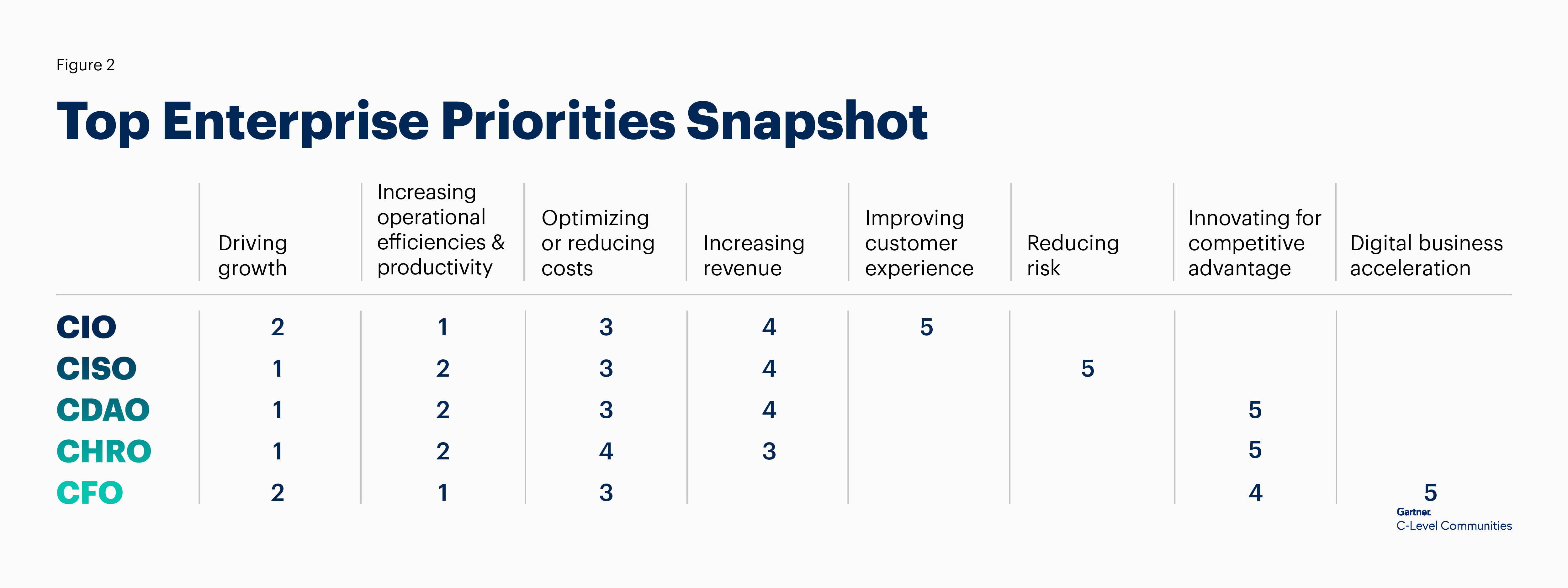
Beyond their core functional responsibilities, CDAOs also addressed their enterprise-wide priorities in our Leadership Perspective Survey. The 2026 results reveal that CDAOs’ top organizational imperatives are closely aligned with those of other C-suite leaders, reflecting a unified executive agenda.
For the second consecutive year, driving organizational growth emerged as the leading enterprise priority for CDAOs, a focus shared by CISOs and CHROs. Increasing operational efficiency and productivity remains the next most significant area of emphasis. In addition to ongoing efforts to optimize costs and increase revenue, innovating for competitive advantage enters their top five enterprise priorities for the first time. This replaces improving customer experience, which was highlighted in 2025.
The table below offers a comparative overview of the top enterprise priorities for CDAOs and their executive peers in 2026.
The Outlook for CDAOs
CDAOs play a pivotal role in driving enterprise growth, operational efficiency, and innovation, all while navigating a landscape transformed by AI, data proliferation, and shifting business priorities. As organizations advance toward enterprise-wide AI deployment and set their sights on agentic AI, CDAOs are sharpening their focus on strengthening data and AI governance to keep pace with evolving ethical, regulatory, and business demands.
In addition to governance, prioritizing high-impact D&A and AI use cases remains crucial for delivering measurable business value. The ability to identify, scale, and operationalize successful use cases will distinguish leading organizations in an increasingly competitive environment.
Another cornerstone for CDAOs in 2026 is building a data-driven culture and driving transformation. Upskilling teams, championing data and AI literacy, and breaking down organizational silos are vital for enabling informed decision-making and fostering innovation. CDAOs who focus on the “people side of transformation” will be well positioned to guide their organizations through ongoing change.
Looking ahead, CDAOs who balance robust governance, strategic use case delivery, and a strong data-driven culture will help their organizations not only navigate uncertainty, but also seize new opportunities in the data and AI-powered future.
CDAOs across Gartner CDAO Communities regularly connect with local peers to discuss critical priorities, share expertise, and learn from one another. To participate in a Gartner CDAO Community, apply to join, or if you are already a member, sign in to learn more and register for your upcoming community events.
Based on 600 CDAO responses from Gartner C-level Communities’ proprietary Leadership Perspective Survey, May 2026.
By CDAOs, For CDAOs™
Find your local community and explore the benefits of becoming a member.